 |
||
History of Ancient Africa in a NutshellThe history of ancient Africa, goes back further then any other civilization or culture on earth. It is widely believed that humankind had its earliest origins in Africa and the story of life in South Africa has proven to be irrevocably linked to the story of life on the continent of Africa.
South Africa is a rich store of fossil evidence that has helped to shed much light on the evolutionary history of humankind, going back several million years. The history of South Africa is irrevocably linked to the history of Africa, one of contrast and diversity, a tribute to all its people who adapted to the challenges of nature with enthusiasm and courage. The history of man in Africa is marked by the evolution of complex societies (chiefdoms and states), migrations, agriculture and pastoralism (a way of life in which people’s livelihood depends on the herding ofanimals within a certain area). When the natural resources are depleted, the herders move on to the next area with similar resources, and a nomadic lifestyle is created. 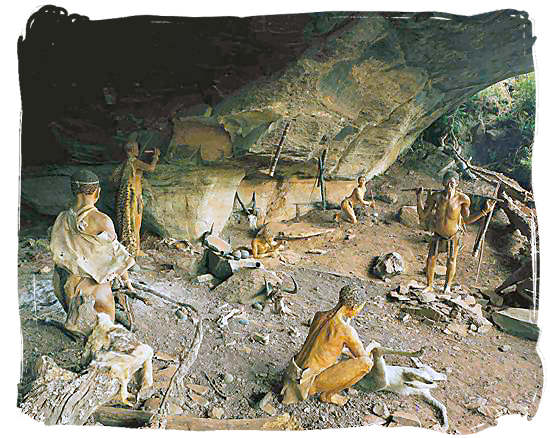 Museum scene of ancient “San” people using the Battle Cave in the beautiful Drakensberg mountains as their shelter – Ancient Africa history copyright © South African tourism The introduction of iron changed the African continent irrevocably and was a large step forwards in the development of its people. Mainly it created the potential for agriculture, which changed the lifestyles of the African people forever. Population numbers rose, more space was needed and a pattern of migration started. The nomadic lifestyle was no longer the only way to live and people were starting to intrude on each other's territories. 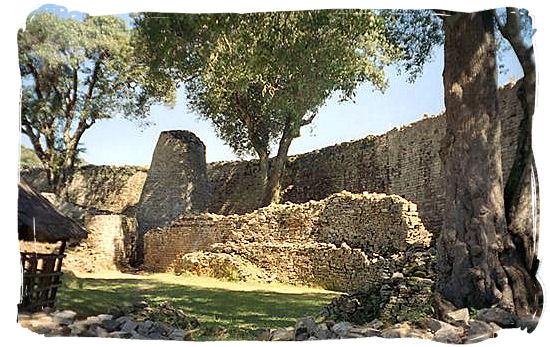 Great Zimbabwe Ruins, remnants of the former capital of the Monomotapa Empire, which reached its climax from 1000-1400 AD - Ancient Africa history copyright © South African tourism However, while farming with implements changed the way of life in Africa, just as it did in Europe, other ways of life were equally important. Nomadic herders were successful in the central part of Africa in the great savannas. Hunters and gatherers continued to survive in limited areas such as the Kalahari Desert in Southern Africa, where life has changed very little over the last 10,000 years. Another complication of the Iron Age was that populations grew more complex and social structures were affected. The histories of African kingdoms, passed on by word of mouth, usually tell of a male founder who persuaded or forced people to accept his rule. Many of these legends refer to the founder-king as a blacksmith, reminding us of the great impact that iron had on African social history. 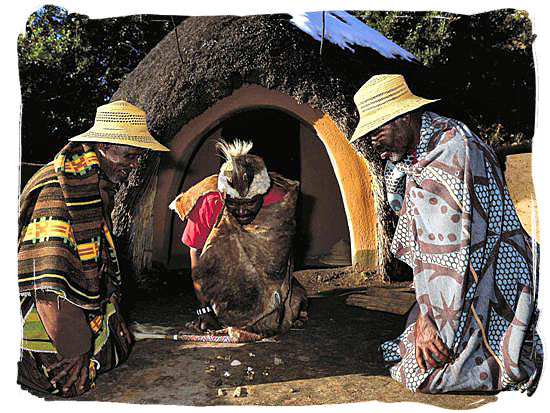 A witch doctor throwing the bones to consult the ancestral spirits - Ancient Africa history copyright © South African tourism Almost all the myths also refer to the presence of supernatural authority behind the power of the ruler. African societies were held together by social control that was tied to this supernatural force. The masks and forms of dress unique to African societies, still serve as a reminder of their strong links to the spiritual world. |
    |
|
|
|
||