-
You are here:
Home
›
-
National parks in South Africa
›
-
Camdeboo National Park
About Camdeboo National Park,
previously known as Karoo Nature Reserve
It is hot in the Camdeboo National Park, previously known as
the Karoo Nature Reserve. Several Black Eagles drift around on the rising warm air caused by the heat on the
valley floor below.
They ignore us, intent as they are on spotting a rock dassie among the rocks on the slopes
around us.
The valley is barren and desolate yet fascinating, by what looks like huge perilously balanced dolerite
pillars up to 120meters high, rising up dramatically from the slopes around it.
Aptly named the "Valley Of Desolation", it is the prime attraction of the Camdeboo National
Park.
From the lookout point on Cave mountain one looks down on the historical town of Graaff-Reinette,
looking like a map laid out on the ground.
One can clearly see that the town is almost encircled by a loop ofthe Sundays river and the Park
itself, as the river forms the boundary between the Park and the town.
Learn more about this amazing South African national park;
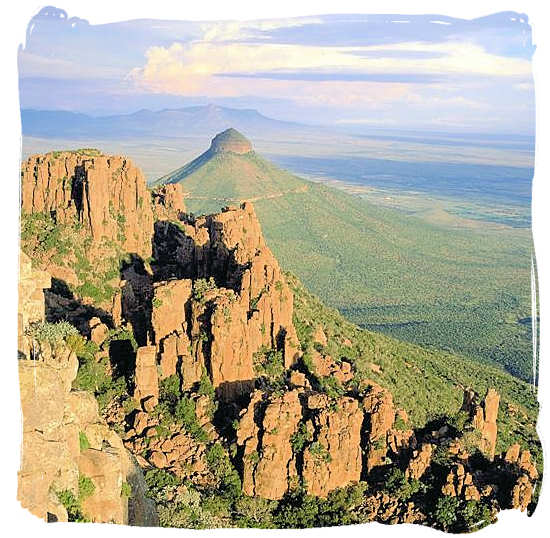
Huge rock columns with Spandou kop (hill) in the background in the valley of desolation
copyright © South African tourism - Camdeboo National Park (previously Karoo Nature Reserve)
General info,...
On the far slopes beyond the town lies still more of the Camdeboo National Park. Apart from its unique and
dramatic landscape, the Park offers exciting flora and wildlife, together with highly interesting
palaeontological sites.
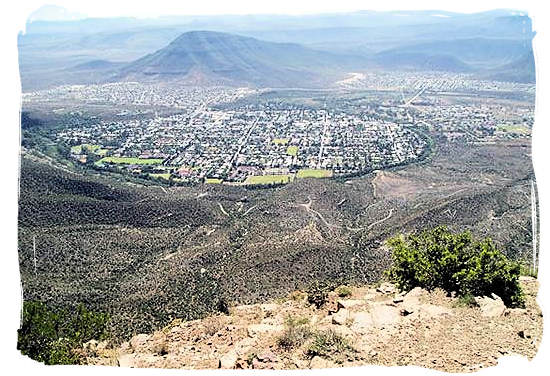
The town of Graaff-Reinette almost encircled by a loop of the Sundays river and the Park itself
Photograph by Chris Lance - Camdeboo National Park (previously Karoo Nature Reserve)
The Karoo Nature Reserve was established in 1979, when the International Union for the Conservation of
Nature and the World Wildlife Fund recognised the urgency for conservation measures in the Karoo biome and
listed this action as a world conservation priority.
Renamed as the Camdeboo National Park, it was proclaimed as South Africa's 22nd National Park under the
management of South African National Parks on the 30th October 2005. Although small, the Camdeboo National
Park with its unique Karoo landscape and ecosystem offers an exciting variety of nature, wildlife and culture
experiences.
The Nqweba Dam lies within the park and covers about 1000 hectares when full. The greater portion of
the Park is situated between 740 and 1480 metres above sea level on the foothills of the Sneeuberg mountain
range. In addition a small section of the low lying-plains is included.
The Camdeboo National Park lies in a circle just east, north and west of the Nqweba dam, which itself lies
just north of the town of Graaff-Reinet. The Park offers walking trails that range from an hour to overnight
hikes, as well as picnic sites for those who simply want to gawp at the majestic rock formations.
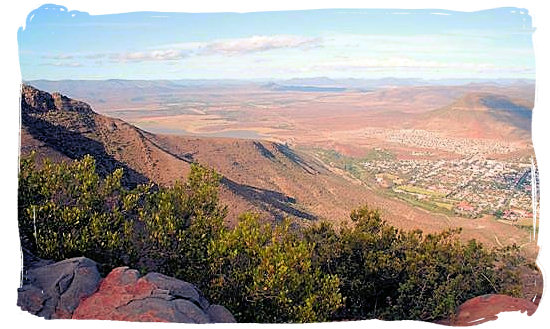
View at Graaff-Reinet down below with the Nqweba dam visible in the left-hand top corner)
Camdeboo National Park (previously Karoo Nature Reserve
Almost encircled by the Camdeboo National Park, the historical 19th century town of Graaff-Reinet is a prime
attraction in itself and well worth a visit. Established in 1786, the town was named after the Governor of
the Dutch governor of the Cape Colony of that time, Cornelis Jacob "van der Graaf" and his wife "Reinet".
As the fourth-oldest town in South Africa it is home to more national monuments then any other town in
the country. Graaff-Reinet also boasts many tourist attractions, from paragliding, micro-light flying, trout
fishing, fossils search, golf and horse riding to mountain biking and guided township walks, to name but a few.
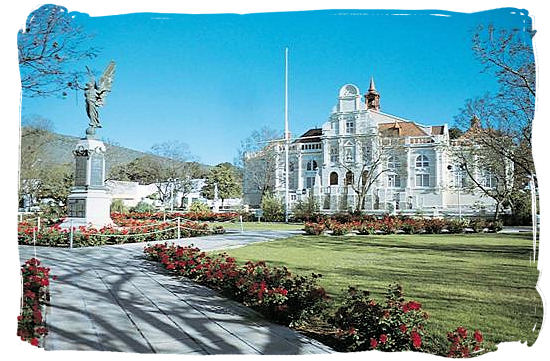
“Reinet House” in Graaff Reinet, excellent example of the Cape Dutch architecture
Camdeboo National Park (previously Karoo Nature Reserve
Graaff-Reinet offers old-world charm and traditional Karoo tranquility amidst all the amenities of a
modern lifestyle. Its long history is on show for all to see, under big trees shading the pavement, along the
long streets and in the whitewashed houses.
The town has a distinctive wild-west feel, yet it is also a modern town with modern facilities. The streets
are quiet and everyone is friendly. No one will bother you, but if you stop and ask someone a question, you
will make a new friend. Called the "Gem of the Karoo", it is one of the most popular small towns in
the country.
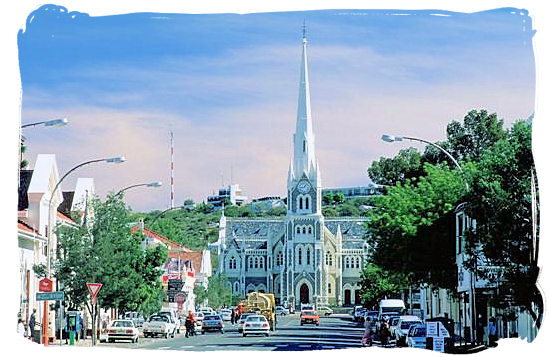
The beautiful Dutch Reformed Church at the end of Church street in Graaff-Reinet
copyright © South African tourism - Camdeboo National Park (previously Karoo Nature Reserve)
In the harsh and variable semi-desert Karoo climate of the Camdeboo National Park it is adapt or die for
its plant life. The vegetation in the Park seems to be constantly battling to survive the extreme heat,
extreme cold, severe drought, floods, poor soil types, brackish water and grazing animals, both wild and
domesticated.
In this process the plant life in the Park has developed wonderful ways to adapt and survive, such as highly
specialised root systems, thorns and abilities to re-root from broken branches and to absorb and store water,
amongst others.
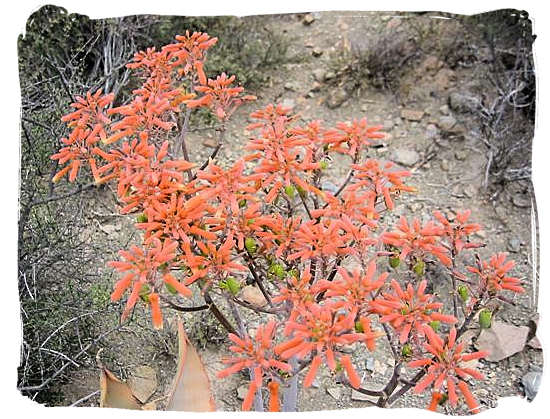
Flowers in the Karoo
Photograph by Tjeerd Wiersma - Camdeboo National Park (previously Karoo Nature Reserve)
The diverse landscape of the Park in relation to altitude, aspect and soil type has led to the development of
three distinct classes of vegetation, shrubland, succulent thicket and dwarf shrubland. To date 336 plant
species have been identified, among which 71 families of flowering plants.
The most important of these are daisies (55 species), grasses (36 species), lilies (25 species) and succulent
Crassula's (16 species). A wetland plant community occurs primarily within the water fluctuation area of the dam.
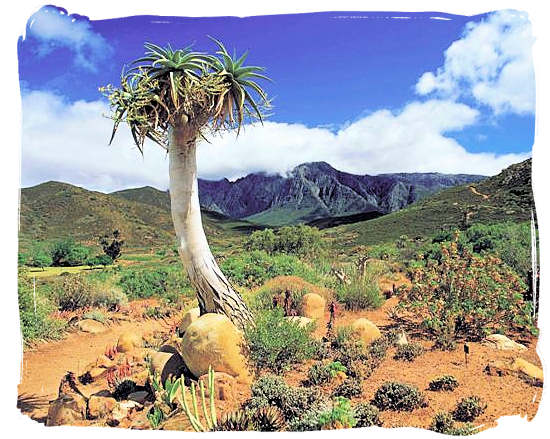
Karoo landscape
copyright © South African tourism - Camdeboo National Park (previously Karoo Nature Reserve)
There are 43 mammal species to be found within the Camdeboo National Park of which 11 are rodents and
13 carnivores. Game animals regularly sighted by visitors include Steenbok, Springbok, Blesbok and Black
Wildebeest in the more open areas.
Thicket inhabitants include the Kudu and Grey Duiker which are common as well as the less often seen Cape
Buffalo. Red Hartebeest and Gemsbok are frequently observed in the transitional vegetation types. Cape
Mountain Zebra may be seen from time to time, but they prefer the more mountainous areas of the reserve.
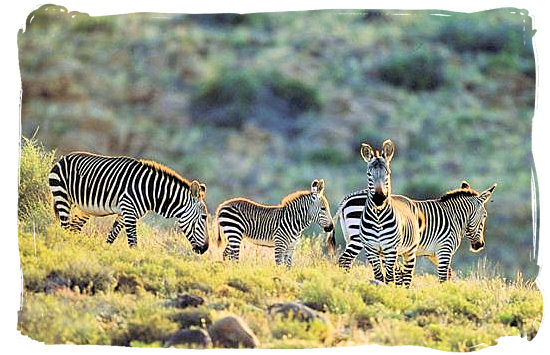
The rare Cape Mountain Zebra
copyright © South African tourism - Camdeboo National Park (previously Karoo Nature Reserve)
At least 225 bird species have been recorded in the Park, with an interesting ecotonal mix including
species typical of both the Great Karoo and eastern region avifaunas. The Ostrich is perhaps the most
well-known example of a bird adapted to life on the plains of the Karoo, it can cover up to 32km per day.
The most common birds in the game viewing area are: Pale Chanting Goshawk, Rock Kestrel, Namaqua Dove,
Diederik Cuckoo, Speckled Mousebird, Brownhooded Kingfisher, Cardinal Woodpecker, Lesser Honeyguide, Anteating
Chat, Longbilled Crombec, Levaillant’s Cisticola, Neddicky and Titbabbler.
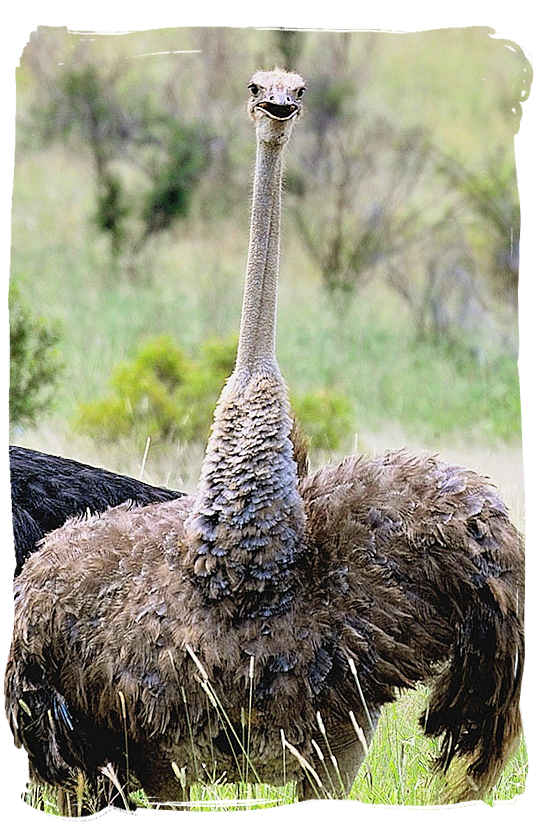
This Ostrich is not smiling
Photograph by Arno Meintjes - Camdeboo National Park (previously Karoo Nature Reserve)
<<< Top of Page
Accommodation,...
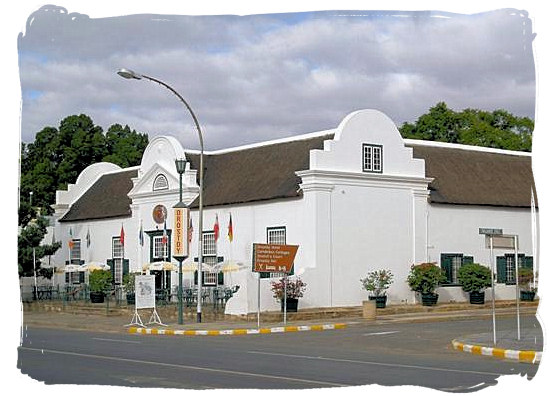
The Drostdy hotel in Graaff-Reinet
Camdeboo National Park (previously Karoo Nature Reserve)
Accommodation facilities run by the park are limited to a single hut used on one of the hiking trails and the
Camdeboo Environmental Education Centre for school groups which can accommodate up to 40 children or can also
be used for conference purposes.
The town of Graaff-Reinet, basically lying in the heart of the Camdeboo National Park so to speak, would be
the perfect place to look for accommodation. There are many good hotels and guest houses in Graaff-Reinet
as well as a beautiful campground directly at the Sunday River.
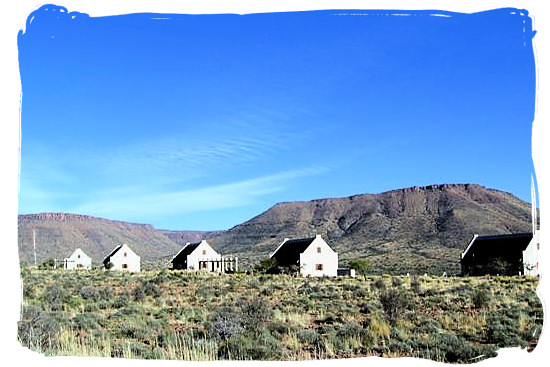
Guest cottages in the Karoo
Photograph by Gemma Longman - Camdeboo National Park (previously Karoo Nature Reserve)
It is the ideal base from which to enjoy both worlds, the Park and the town itself with the dam and its
surroundings. The people of Graaff-Reinet and its surrounding farms are renowned for their out-going
hospitality, easy-going warmth and down-to-earth friendliness.
Their warm personalities are reflected in their accommodation establishments. Whether you choose to stay in
the historic town or on a farm nearby, you will be bowled over by great lodgings, a warm welcome and comfort
you can truly relax in.
Find the perfect accommodation for a memorable family holiday, a refreshing overnight stop.
<<< Top of Page
Facilities,...
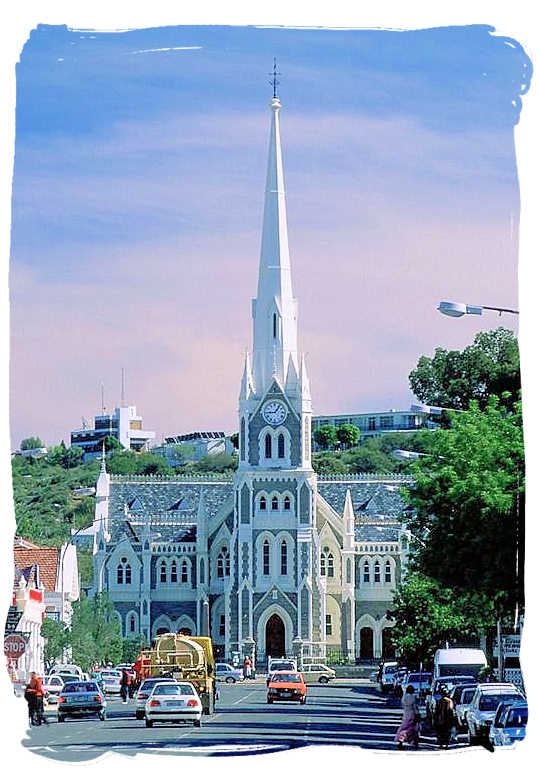
Dutch Reformed Church in Church street Graaff-Reinet
copyright © South African tourism - Camdeboo National Park (previously Karoo Nature Reserve)
Game viewing
Presently, approximately 19km of gravel roads provide visitors with the opportunity to view the entire range
of the Parks' indigenous species in their preferred habitats. Leisure facilities have been built on the
edges of the Park to cater for the more general needs of visitors. The Impunzi picnic area has four sites
suitable for family outings. Each site is provided with a "braai" (barbecue) stand, picnic table and refuse
drum. Water is available and the picnic area is provided with a toilet
Camdeboo Environmental Education Centre
The Camdeboo Environmental Education Centre offers programmes to any formal group to promote awareness of and
sensitivity towards the natural environment. Courses are tailored to meet visitors' needs up to a maximum of
40 people and may extend from one to four days. A nominal tariff is payable. This centre may also be booked
for a team building or conference purpose.
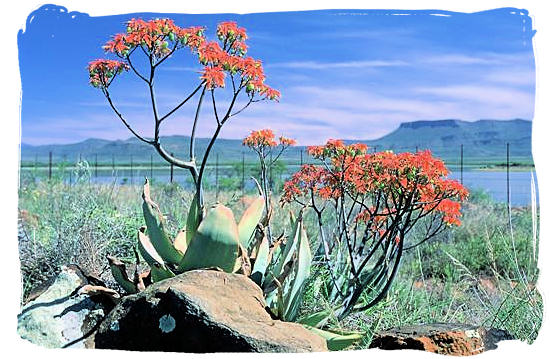
Flowering Aloes with the Nqweba dam in the back ground
Camdeboo National Park (previously Karoo Nature Reserve)
Gannalapa
Gannalapa is an outdoor recreation facility development for use by the local community as well as tour groups
who wish to hold a social function around picnic or 'braai' activities. It includes a bar, kitchen, toilets,
braai circle with seating and picnic tables.
Comprehensive overview
of all the facilities, shops and services that are available in Graaff-Reinet.
<<< Top of Page
Climate,...
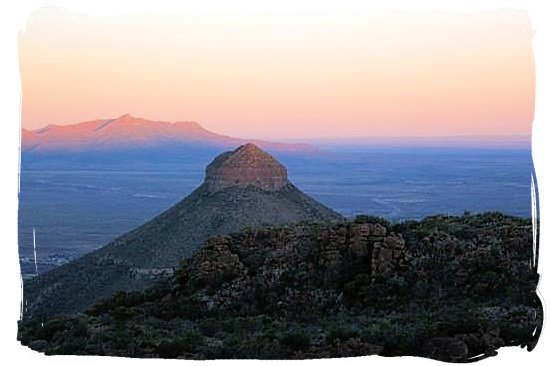
The sun is setting overt Spandou kop (hill)
Photograph by Tim Parkinson - Camdeboo National Park (previously Karoo Nature Reserve)
Camdeboo National Park is located in a summer rainfall, semi-desert area. Summers are very hot with
temperatures averaging around 31°C with peaks up to 40°C. During the summer months, visitors may want to
confine their activities to early mornings and late afternoons, taking it easy around the swimming pool.
Winters can be quite cold with temperatures averaging around 6,1°C, often dropping below zero at night.
Most of the average rainfall of 336mm per annum occurs in summer and autumn, with a peak in March.
Thunderstorms and high temperatures are common during the summer months while snowfalls can occur in the
high-lying areas in winter.
The
interactive weather forecast for the Camdeboo National Park region, delivers condition,
temperature, pressure, and wind information. It also allows you to instantly click over to detailed forecast
information, radar images, and travel information.
<<< Top of Page
How to get there,...
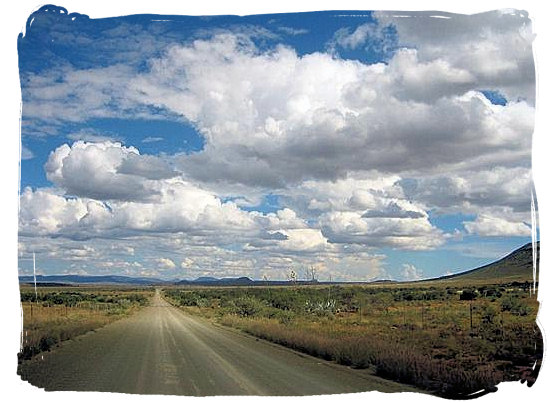
A gravel road in the Karoo
Camdeboo National Park (previously Karoo Nature Reserve)
BY AIR:
The nearest international airport is in Cape Town and the nearest domestic airport in Port Elizabeth.
BY ROAD:
From Cape Town, take the N1 highway towards Beaufort West. Pass through the town of Beaufort West and
then turn right onto the R61 to Aberdeen. At Aberdeen, turn left on the N9 towards Graaff-Reinet.
From Cape Town to Graaff-Reinet is approximately 600km.
From Beaufort West to Graaff-Reinet is 209km.
From Port Elizabeth, take the R75 to Kleinpoort and Wolwefontein Just before you enter Wolwefontein,
turn right and continue with R75 to Jansenville and Graaff-Reinet
From Port Elizabeth to Graaff Reinet is 251km.
When entering Graaff-Reinet, you will enter on College Road. If you want to continue to the entrance
of the Park and the Valley Of Desolation, continue with College Road, which becomes Church Street. You will
see the “Old Dutch Reformed Church” ahead of you. Vehicles can only turn left around the church and will
then come to a stop street.
Turn left at the stop street into Caledon Street and proceed down the street. At the four-way stop, turn right
into the road towards Murraysburg. Keep going onto the road to the Valley of Desolation. The entrance to the
park is 8km from Graaff-Reinet on the Murraysburg road.
<<< Top of Page
-
Home
›
-
National parks in South Africa
›
-
Camdeboo National Park